
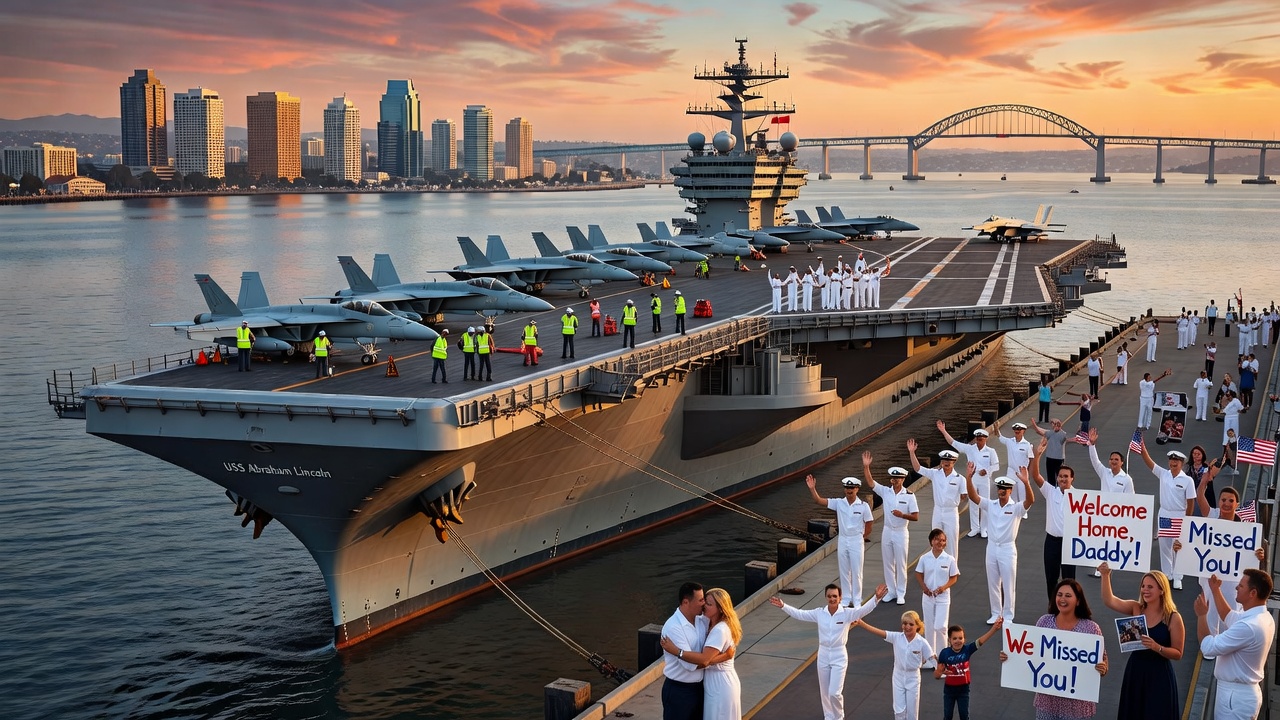
Nearly ten months after departing San Diego, the USS Abraham Lincoln has come home, closing out one of the most demanding deployments a U.S. aircraft carrier strike group has undertaken in recent memory. The ship and its escorts went more than 260 consecutive days without a single port call, according to the Pentagon, a stretch that reflects both the intensity of recent operations against Iran and the human cost borne by the sailors who carried them out.
A Deployment Defined by Sustained Combat Operations
Defense Secretary Pete Hegseth detailed the scope of what the Lincoln's crew accomplished at sea: thousands of combat sorties flown and hundreds of Tomahawk missile launches conducted in support of military action against Iran. Carrier strike groups are built for exactly this kind of sustained power projection, but the scale described here goes well beyond a routine deployment cycle. A carrier air wing operating at that tempo for months without relief places enormous strain not just on aircraft and equipment, but on the maintenance crews, flight deck personnel and support staff who keep operations running around the clock.
Port calls are not simply a morale perk. They allow for resupply, maintenance windows, and a psychological reset for crews living in close quarters for extended periods. Going without one for over 260 straight days is an operational anomaly, and it signals how urgent and continuous the mission demands were throughout this deployment.
The Human Toll of Extended Deployments
The Navy reported eight suicide attempts among sailors in the Lincoln strike group during the deployment. That figure, disclosed alongside the broader operational details, points to a dimension of military service that rarely receives the same attention as missile counts or sortie totals: the mental health burden of prolonged isolation, combat stress, and separation from family support systems.
Shipboard life during an extended combat deployment compounds ordinary stressors. Sailors are confined to a steel environment with limited privacy, irregular sleep cycles tied to flight operations, and no reliable way to decompress. When a deployment stretches toward the ten-month mark with no port relief, the Navy's existing mental health resources, shipboard counselors, chaplains, peer support programs, are tested at a scale they were not necessarily designed to absorb continuously. The eight reported attempts are a concrete reminder that operational success and crew welfare are not automatically aligned, and that sustained high-tempo missions carry costs that extend past the battlefield.
What Comes Next for the Strike Group and the Region
With the Lincoln now docked in San Diego, families are being reunited after a deployment far longer than the standard six-to-seven month rotation the Navy typically targets. But the broader U.S.-Iran tension that drove this deployment has not resolved. Regional security dynamics remain unsettled, and global energy markets continue to react to the uncertainty surrounding Gulf shipping lanes and Iranian military posture.
The Navy will now face its own set of questions: how to rotate carrier assets without repeating a deployment of this length, how to reinforce mental health support for crews facing similarly intense missions in the future, and how to balance the strategic need for continuous presence in contested regions against the finite endurance of the people who make that presence possible. The Lincoln's homecoming closes one chapter, but the pressures that produced such an unusually long deployment remain very much active.