
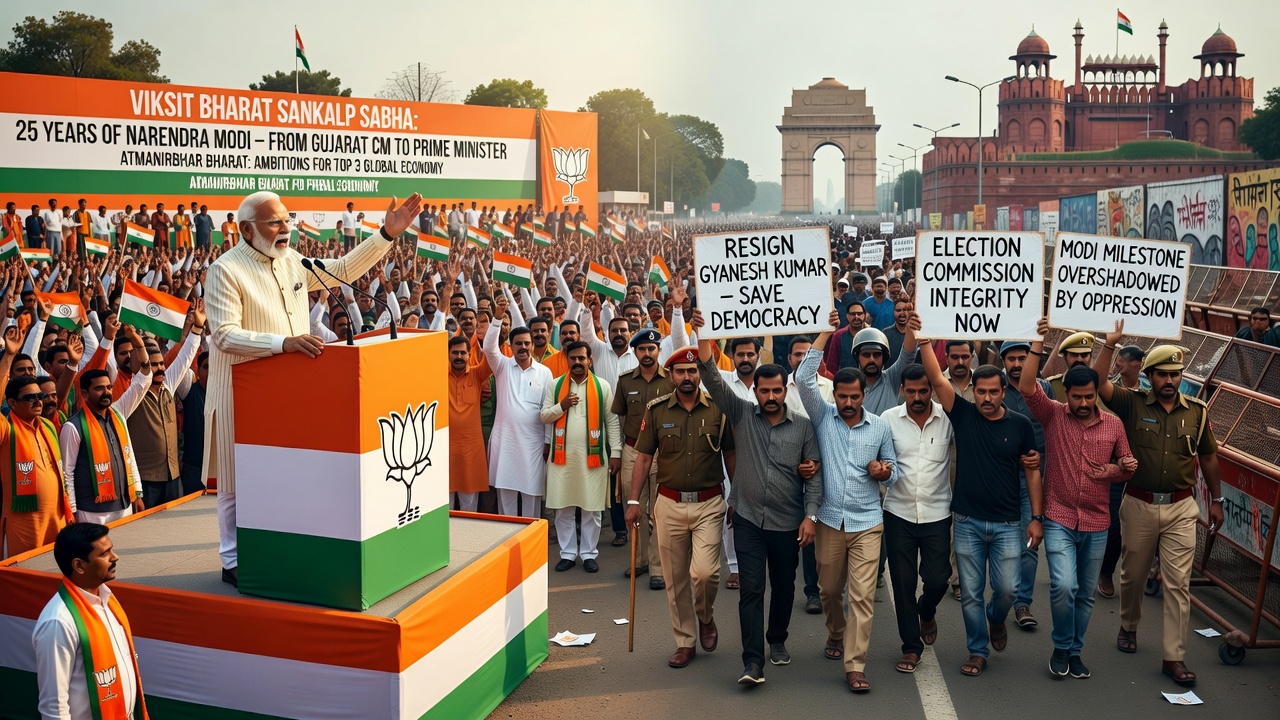
Police detained opposition leaders in New Delhi for a second straight day as they attempted street protests demanding the resignation of Chief Election Commissioner Gyanesh Kumar. The demonstrations unfolded even as Prime Minister Narendra Modi marked 25 years as an elected head of government, a tenure spanning his years as Gujarat Chief Minister and his current term as Prime Minister. The convergence of a governance anniversary celebration and a confrontation over electoral institutions has placed competing narratives about Indian democracy on public display simultaneously.
A Milestone Celebration Amid Institutional Friction
At the Viksit Bharat Sankalp Sabha, organized by the Bharatiya Janata Party, Modi laid out ambitions to push India among the world's top three economies as part of the Atmanirbhar Bharat vision. Such events typically function as both retrospective and forward-looking exercises, reinforcing a governing party's achievements while setting benchmarks for the years ahead. The timing is notable: the same week that the ruling party showcases economic self-reliance goals, opposition parties are using the street to question the independence of the body that administers India's elections. That juxtaposition is not accidental. Opposition parties have long argued that the perception of institutional neutrality matters as much as its substance, particularly around appointments to bodies like the Election Commission.
What the Protests Signal About Institutional Trust
Repeated detentions of opposition figures, rather than quelling the controversy, tend to amplify it. When leaders are taken into custody for attempting peaceful demonstrations, the optics often shift public attention away from the original grievance and toward questions of proportionality and civil liberties. This is a familiar pattern in democracies where opposition mobilization clashes with law-and-order enforcement: the method of response becomes part of the story. For an electoral body, sustained public questioning of its leadership carries consequences that go beyond a single news cycle. Confidence in election administration underpins the legitimacy of every subsequent vote count, and once that confidence is publicly contested, restoring it typically requires more than official denials.
Economic Narrative and Rural Realities
Separately, a panel of political analysts reviewed the government's broader record, weighing economic policy, rural electrification, and welfare programs against opposition concerns about democratic backsliding. These assessments rarely yield a single verdict; governance performance and institutional health are evaluated on different axes, and strong marks on one do not offset weak marks on the other. That tension is visible in Karnataka, where the state government has declared 217 taluks drought-affected after a deficient monsoon season. Central assessment teams are now reviewing crop losses in districts including Tumakuru and Dharwad, with affected farmers demanding financial compensation. Agrarian distress of this scale tests the same welfare architecture that national leaders cite as evidence of progress, making the Karnataka drought response a practical measure of whether rural support systems function when actually needed.
Why This Matters Beyond New Delhi
The episode illustrates a recurring dynamic in large democracies: anniversaries and achievements are announced on one track while grievances about institutional fairness play out on another, often in the same news cycle. Readers evaluating these events benefit from separating three distinct questions - whether economic and welfare claims hold up to scrutiny, whether the Election Commission's leadership and conduct meet standards of independence, and whether state responses to protest are proportionate. Conflating these risks either excusing institutional concerns because of economic performance, or dismissing genuine governance gains because of a separate controversy. Both the Karnataka drought response and the Election Commission dispute will likely be judged not by this week's headlines but by how authorities act on compensation claims and institutional reform in the months that follow.