
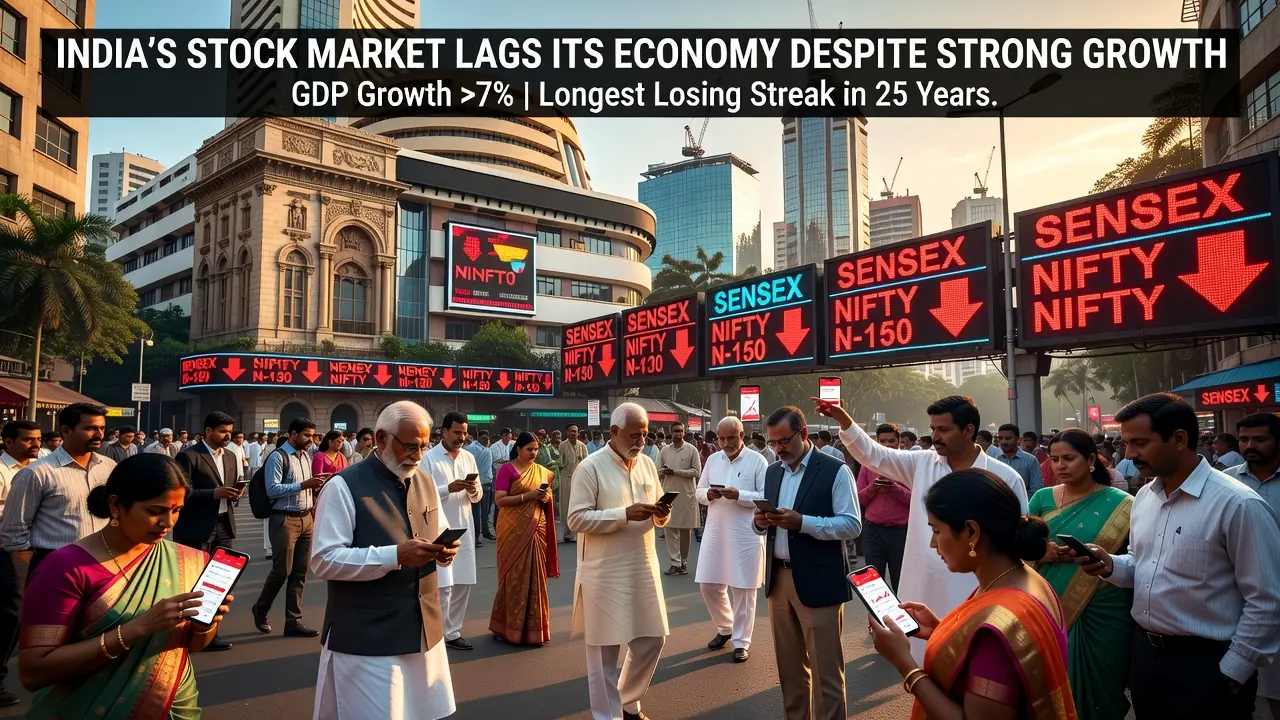
An economy expanding above 7% a year would normally be expected to power a buoyant stock market. India's is doing the opposite. The Sensex and Nifty have just ended the longest losing streak in a quarter-century, and the disconnect between macroeconomic strength and equity performance has become one of the more puzzling stories in global finance this year.
A growth story that investors aren't rewarding
India remains the fastest-growing major economy, absorbing energy shocks, tariff disputes and rate pressures that have unsettled other markets. Yet its benchmark indices rank among the weakest performers of 2026 globally. Retail investors who poured savings into the Nifty have watched roughly 15% of their wealth disappear this year, a stark contrast to markets like South Korea's Kospi, which have delivered far stronger returns over the same period and over the past two years. The gap illustrates a basic truth about equity markets: economic growth and market returns do not move in lockstep, especially when valuations, currency and global capital flows intervene.
Oil, interest rates and a weakening currency
Continued disruption in the Strait of Hormuz has kept crude oil elevated, and India imports the overwhelming majority of its energy needs. When prices push past the $100-a-barrel range, the effect ripples through inflation, corporate margins and the broader macro picture, making equities less attractive even when underlying growth holds up. At the same time, elevated US bond yields have given global capital a safer, more liquid alternative, pulling foreign institutional money out of emerging markets, India included. A weaker rupee compounds the damage for overseas investors, eroding dollar-denominated returns regardless of how Indian companies perform in local currency terms.
Valuations, structure and the missing technology layer
Indian equities have grown cheaper relative to their own history, narrowing the premium they once held over other emerging markets. But on earnings multiples they remain comparatively expensive, particularly against markets like South Korea and Taiwan, where companies have captured outsized profits from the global boom in artificial intelligence infrastructure and chipmaking. India has yet to produce a globally dominant AI company, leaving a structural gap in its market composition. Many of its largest listed firms are seen as legacy businesses rather than innovators, while smaller companies working in areas such as space, defence and semiconductors remain too small to shift capital allocation meaningfully.
Why domestic money is the real stabiliser
The one force keeping Indian markets from a steeper decline is domestic capital. Mutual fund assets under management have grown enormously over the past decade, and the number of Indians investing in stocks and funds has multiplied several times over. That steady, recurring flow of retail savings has absorbed much of the selling pressure from departing foreign investors. But this resilience carries its own risk. Many of these households are already contending with a soft job market and high living costs, and a deeper or prolonged downturn would test whether retail investors keep investing through losses or pull back when it matters most. Upcoming corporate earnings will offer the first real signal of how much pressure margins have actually absorbed.