
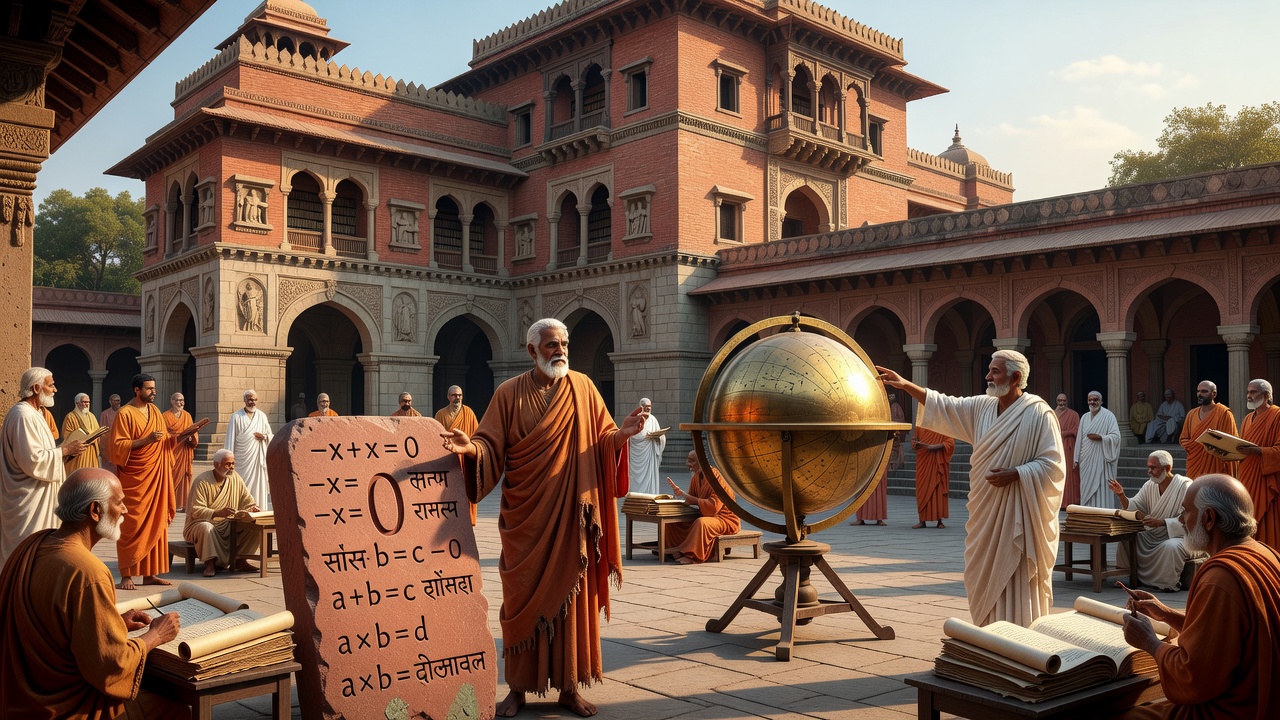
A concept as simple as zero reshaped how the world calculates, builds and reasons. That idea, refined by Indian mathematicians more than a thousand years ago, now sits quietly inside every computer, spreadsheet and financial transaction on the planet. The story of how it got there says as much about institutions and intellectual culture as it does about any single breakthrough.
Zero and the mathematics of the cosmos
Brahmagupta's seventh-century work did not merely use zero as a placeholder, as earlier numeral systems sometimes did. He treated it as a number in its own right, setting out rules for arithmetic involving zero and negative numbers. That shift mattered enormously: it allowed mathematics to move from counting objects to manipulating abstract quantities, a foundation later carried into Arabic scholarship and, from there, into European algebra. Aryabhata, working slightly earlier, approached the sky with similar rigour. He proposed that the Earth rotates on its axis and offered explanations for eclipses based on the mechanics of shadows rather than myth. These were not isolated guesses; they emerged from sustained observation and calculation, passed between scholars across generations.
Medicine, metallurgy and engineering built on method
The Sushruta Samhita, an ancient medical compendium, describes surgical techniques including early forms of reconstructive procedures, along with instruments and clinical reasoning that predate similar developments elsewhere by centuries. This was medicine grounded in observation, categorisation and recorded experience, not isolated anecdote. Parallel to this, Indian metallurgists produced Wootz steel, a high-carbon crucible steel prized for its strength and edge retention, later traded across the Middle East and used in blades Europeans would come to call Damascus steel. Cities of the Indus Valley period, far earlier still, had engineered drainage systems that managed waste and water at a scale unusual for their time, pointing to planning knowledge embedded in everyday urban life rather than confined to elite scholarship.
Why institutions mattered as much as individuals
None of this knowledge survived by accident. Centres of learning such as Nalanda functioned as organised institutions, drawing students and teachers from distant regions, maintaining libraries, and supporting debate across disciplines including logic, medicine and astronomy. This infrastructure of learning is what allowed individual insights to be tested, recorded and transmitted rather than lost with a single scholar's death. It is a useful reminder that innovation rarely survives on brilliance alone; it depends on systems that preserve, question and refine ideas over time.
A pattern worth recognising
What links zero, surgical technique, metallurgy and civic engineering is not coincidence but a shared intellectual habit: close observation, systematic recording and willingness to debate conclusions. That pattern, more than any single invention, is what allowed Indian scholarship to influence mathematics in the Islamic world, medicine across Asia and metallurgy in global trade networks. Understanding that history offers more than historical curiosity. It is a case study in how durable knowledge is built - through institutions, documentation and the slow, unglamorous work of verification, rather than through isolated moments of genius.