
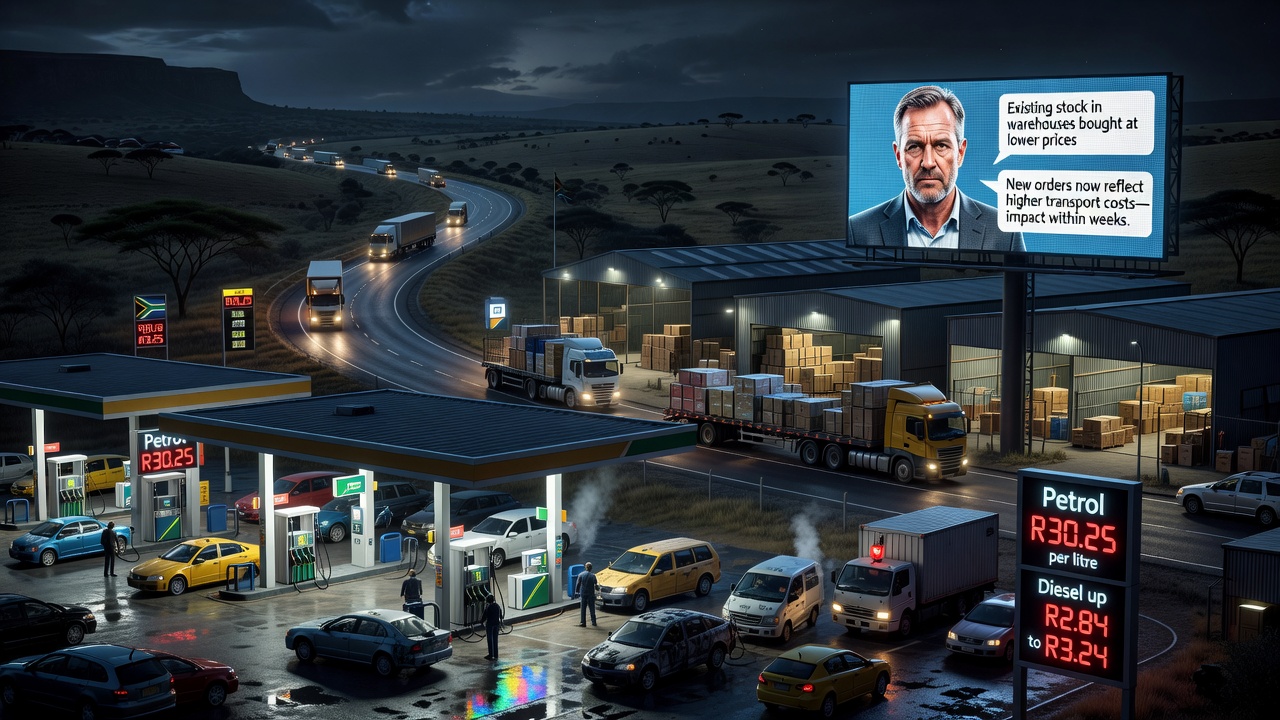
Petrol crosses the R30-a-litre threshold from midnight on Wednesday, climbing to roughly R30.25, while diesel rises by between R2.84 and R3.24 a litre. The increase will not hit shop shelves straight away, but the Road Freight Association warns that the knock-on effect on everyday goods is only a matter of time.
Why the price shock is delayed
Road Freight Association CEO Gavin Kelly explains that most goods currently moving through South Africa's supply chain were ordered weeks ago and are already sitting in warehouses. Transport contracts and purchase orders are typically locked in ahead of delivery, meaning retailers are working through stock bought at the old fuel price. Kelly says consumers are unlikely to notice a difference immediately, with the real impact expected to surface within the next month or so, once that existing stock is depleted and new orders reflect higher transport costs.
Smaller operators absorb the hit first
Not every player in the freight industry feels the pinch at the same pace. Kelly points out that smaller transport operators are the most exposed, because they typically buy fuel at retail forecourts like ordinary motorists. Larger freight companies, by contrast, often secure discounted rates by purchasing fuel in bulk directly from depots, giving them more room to manage sudden increases.
That buffer is not unlimited. Kelly cautions that even the biggest operators can find themselves under serious financial pressure when fuel costs rise sharply, since diesel is one of the largest line items in any trucking business. A squeeze on margins at this level inevitably feeds into what operators charge retailers, which in turn shapes what consumers eventually pay.
A structural problem, not just a price spike
Kelly frames the latest increase as part of a broader vulnerability: South Africa's heavy reliance on imported petroleum products. He argues the country should make greater use of its own coal reserves to produce fuel domestically, pointing to Sasol's existing coal-to-liquid capability as a resource that could reduce exposure to volatile international markets.
His comments touch a long-standing debate about energy security in South Africa, where fuel prices are closely tied to global oil markets and the rand's exchange rate. Both factors sit largely outside domestic control, which means price shocks like this one tend to recur whenever international conditions shift, regardless of local economic performance.
What it means for households
For consumers, the lag between a fuel increase and higher retail prices can create a false sense of stability. Prices on staples, especially those transported over long distances, typically adjust once current inventory cycles through the supply chain. Businesses facing higher logistics costs generally pass at least part of that increase on to buyers rather than absorb it indefinitely, particularly in an environment where margins are already thin across retail and manufacturing.
- Petrol rises to about R30.25 a litre from midnight Wednesday
- Diesel increases by R2.84 to R3.24 a litre
- Existing warehouse stock delays the impact on shelf prices
- Smaller freight operators face immediate cost pressure at the pump
- Domestic fuel production remains a proposed long-term buffer against import reliance