
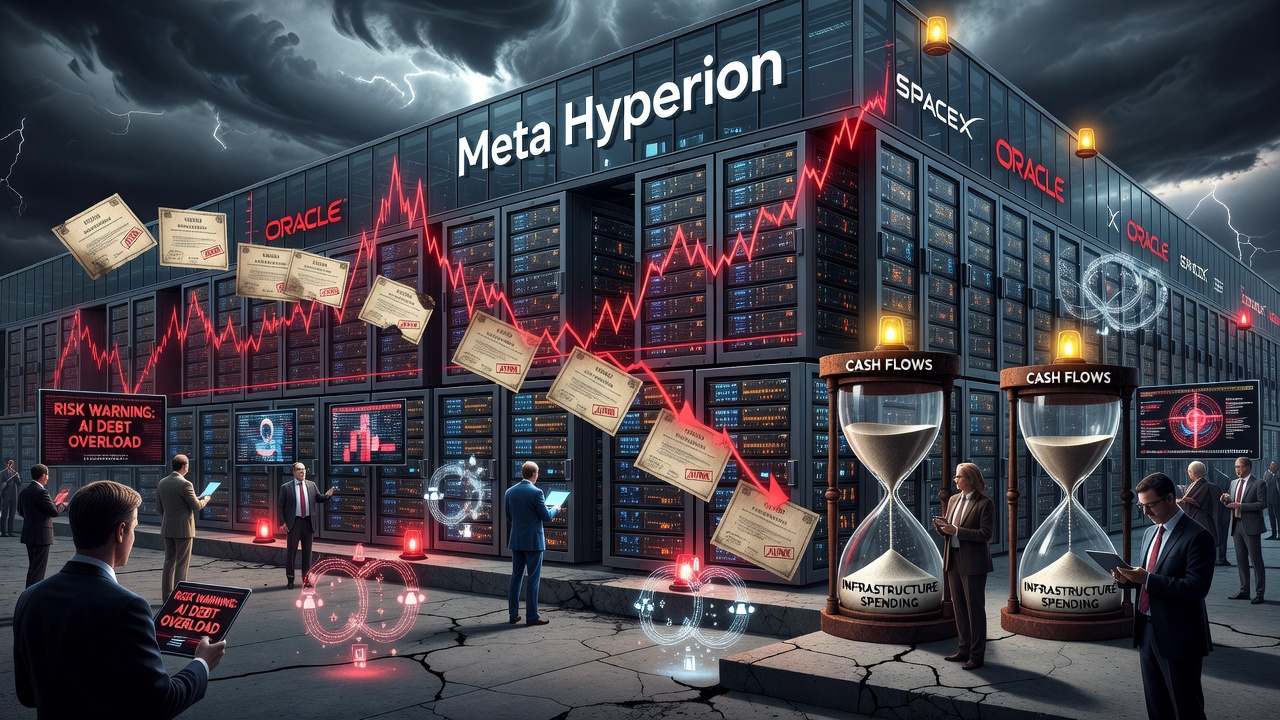
Bond investors are starting to price in doubt about the AI buildout's financial underpinnings. Credit default swap spreads tied to SpaceX have widened, Oracle's bond yields are climbing alongside record CDS levels, and high-yield debt linked to Meta's Hyperion data center has touched record lows. None of this means the money stops flowing. It means the market is beginning to ask harder questions about who actually gets paid back, and when.
Why Companies Are Borrowing Instead of Spending Cash
The scale of AI infrastructure spending - chips, data centers, power contracts, networking gear - has pushed even cash-rich companies toward debt markets. Issuing bonds lets a company lock in capital now without diluting equity or draining reserves needed for operations elsewhere. For a company like SpaceX, which reportedly moved to raise debt shortly after other capital events, the logic is straightforward: the AI compute race rewards speed, and speed costs money upfront, long before revenue from that infrastructure materializes.
The complication is timing. Once bonds are sold and the cash is in hand, weakening performance in the secondary market is mostly a reputational problem, not an operational one - the issuer already has what it needed. But it matters enormously for future financing. Widening spreads and falling bond prices signal to the next round of lenders that risk is rising, which can push borrowing costs higher or shrink investor appetite altogether.
The Real Question: Duration, Not Demand
Nobody disputes that buyers exist for this debt. Capital is clearly flowing toward AI-linked credit, which is part of why other sectors are feeling crowded out of financing. The unresolved issue is how long this can continue without a visible stumble. Infrastructure spending of this magnitude only makes sense if the computing capacity being built gets used - and monetized - fast enough to service the debt taken on to build it.
That is a cash-flow problem at its core. Data centers and chip fleets are capital-intensive assets with long payback horizons. If enterprise adoption of AI tools lags behind the pace of infrastructure spending, the companies holding this debt could face a mismatch between when bills come due and when revenue arrives to cover them.
Demand Is Real, But So Is the "Push" Problem
Box CEO Aaron Levie has argued that the compute needs ahead - agent swarms, automated security review, large-scale enterprise data processing - will require enormous inference capacity. That's the bullish case for continued infrastructure investment. But it also raises a circular concern: some of the projected demand is being generated by AI systems built to manage problems created by other AI systems, which makes it harder to separate organic need from manufactured urgency.
This echoes an earlier critique of the AI narrative - that it initially looked like a push from technology vendors insisting adoption was inevitable, rather than a pull driven by proven customer demand. Companies that have integrated AI tools effectively report real gains. But broader adoption is likely to be uneven and slower than the infrastructure spending curve assumes, which is precisely the gap credit markets are starting to price into bond yields and CDS spreads.
What It Means for Investors and the Broader Market
- Rising CDS spreads on SpaceX and Oracle reflect increased perceived default risk, even without any missed payment.
- Record-low pricing on Meta's Hyperion-linked high-yield bonds suggests investors are demanding steeper discounts to hold this debt in secondary trading.
- Continued bond issuance shortly after major capital raises, as seen with SpaceX, can signal urgent capital needs that outpace near-term revenue generation.
- The core risk isn't whether AI compute demand exists - it's whether revenue from that demand arrives quickly enough to service the debt funding the buildout.
None of this guarantees a crisis. Debt-financed infrastructure booms have happened before, in telecom and energy, with mixed outcomes depending on how closely spending tracked eventual usage. The current credit market signals are not a verdict - they're an early warning that the gap between AI infrastructure investment and AI infrastructure payoff is being watched closely by the people whose job is to price risk.