
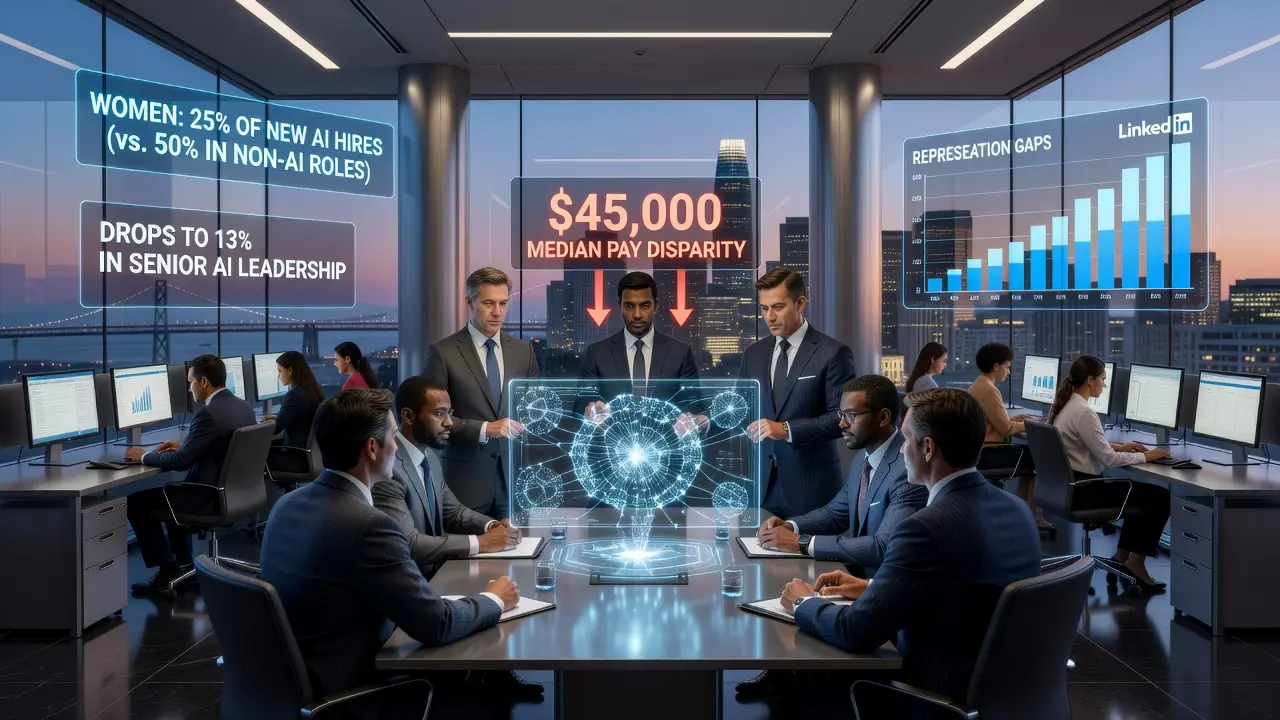
A hiring boom meant to reward technical skill over pedigree is reproducing the same imbalances that have long defined Silicon Valley. Women made up roughly a quarter of new hires into AI-specific roles over the past year, compared with half of new hires in non-AI positions, according to LinkedIn research cited by industry observers. In senior AI leadership, the share of women drops to about 13%.
A new economy, an old pattern
AI job postings have roughly doubled since 2023, and these roles now carry a substantial pay premium over comparable non-AI positions. That premium is exactly why the gender gap matters: when a fast-growing job category pays more than double the baseline, who gets hired into it determines who benefits from the next phase of the tech economy. Women who do work in AI are disproportionately clustered in lower-paying functions, such as data annotation, rather than the research, engineering, and leadership roles commanding the highest salaries. The result, according to LinkedIn's Sarah Steinberg, is a median pay gap of roughly $45,000 between men and women across AI occupations - driven not only by unequal pay for equal work but by unequal access to the roles that pay the most.
Why a "meritocratic" field isn't acting like one
AI is young enough that no one holds a decade of experience with any given model or framework, which in theory should level the field. In practice, hiring still runs through established networks, referrals, and informal signals that have historically favored men. Founders describe a credibility gap as well: Urvashi Batra, co-founder of Prioriwise, said investors respond differently depending on which co-founder leads a pitch. Workplace dynamics compound the problem - being the only woman on an engineering team, according to AI lead Jayeeta Putatunda, often means having to work harder simply to be heard, with limited access to mentorship from other women already in the field.
Speed, caregiving, and who gets left behind
The pace of AI development creates its own barrier. Models and frameworks shift quickly enough that even a few months away from the field - maternity leave, for instance - can mean returning to a landscape that looks unrecognizable. Putatunda described this exact experience, noting that catching up required both supportive colleagues and an equitable division of childcare at home. Without that infrastructure, she argues, talented women are pushed out - not for lack of ability, but for lack of support systems built around a culture of extended hours.
Shrinking institutional support
Efforts to close these gaps face a tougher political environment than in years past. Federal scrutiny of corporate diversity, equity, and inclusion programs - including Department of Justice enforcement actions that have produced multimillion-dollar settlements from major companies - has made employers more cautious about funding women-focused initiatives. Felicia Newhouse, founder of AI Powered Women, says this has made it harder to secure corporate buy-in for programs explicitly aimed at women, even as advocates warn that the underlying hiring gap is widening. The concern voiced across the industry is structural: if participation in AI's highest-paying roles stays this skewed, a hiring gap today becomes an entrenched economic and decision-making gap for a generation.