
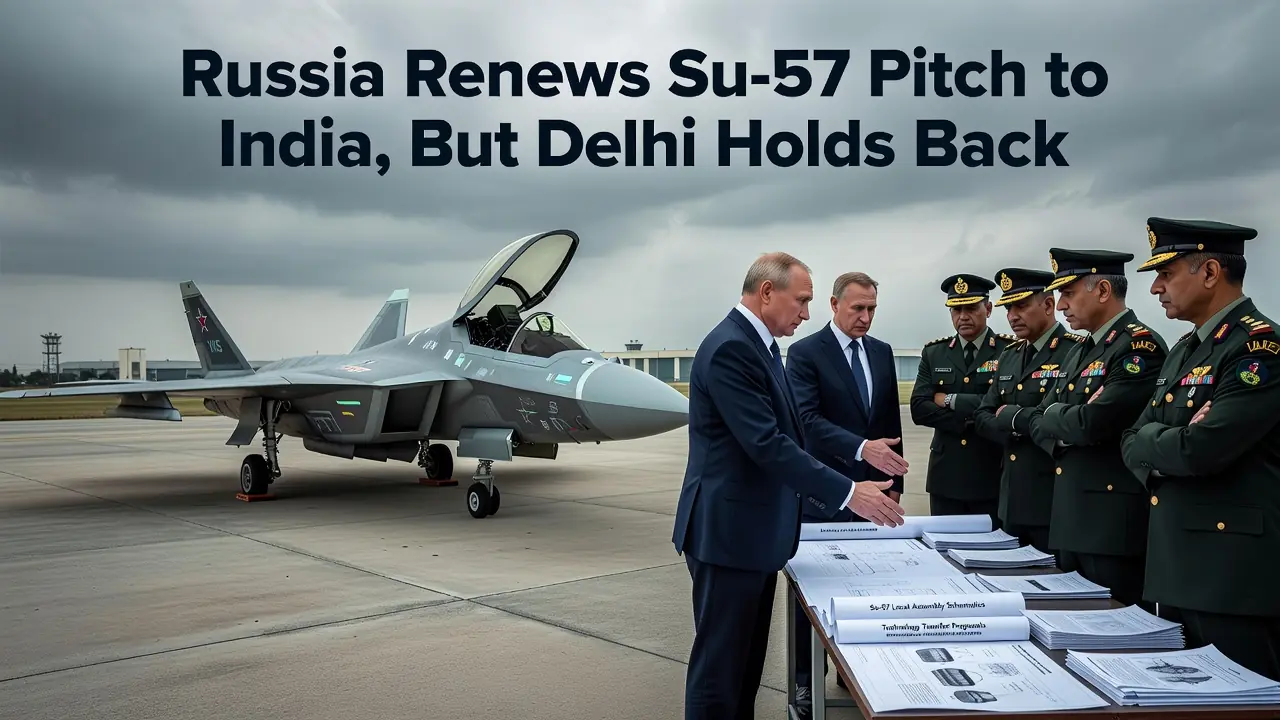
Moscow is once again courting New Delhi with its Su-57 stealth fighter, dangling technology transfer and local assembly as sweeteners. India has heard this offer before, and it still isn't buying. The reluctance traces back to a partnership that collapsed years ago and has never fully recovered its credibility in Indian defence circles.
A Partnership That Ended in Exit
India and Russia once worked together on the Fifth Generation Fighter Aircraft programme, an attempt to co-develop a stealth jet based on what became the Su-57. India walked away from that programme in 2018. The stated concerns were specific: doubts about the aircraft's stealth characteristics, unresolved engine performance issues, and costs that kept climbing without matching commitments on technology sharing. Those three complaints - stealth, engines, cost - have shaped Indian thinking ever since, and they resurface every time Moscow renews its pitch.
Trust, once damaged in a defence partnership, is expensive to rebuild. India's air force procurement decisions involve decades-long commitments, maintenance ecosystems, and training pipelines. Walking back into an arrangement that previously fell apart over disclosed technology and shared costs would require Moscow to offer terms substantially better than before. So far, India has not been convinced that's on the table.
Questions Over Numbers and Combat Record
Part of the hesitation stems from unresolved questions about the Su-57 itself. Production figures have been modest compared to other fifth-generation programmes, and delivery timelines to Russia's own air force have faced delays. The aircraft's combat history, including reported use in Ukraine, has not produced the kind of clear, independently verified performance data that would settle doubts about its stealth signature or operational reliability under contested conditions.
For a country making a multi-decade procurement decision, ambiguity of this kind is a serious obstacle. India has watched other fifth-generation programmes mature with clearer production cadences and more transparent testing records. Without comparable clarity from Russia, the Su-57 remains, in Indian assessments, an aircraft defined as much by open questions as by demonstrated capability.
Why Russia Keeps Returning to the Table
Russia's motivation is not difficult to read. Defence exports generate revenue and strategic influence, and India has historically been one of Moscow's largest arms customers. Losing India as a prospective Su-57 buyer would be both a commercial setback and a symbolic one, signalling that even a long-standing partner is diversifying away from Russian platforms. Framing the Su-57 as a "bridge" aircraft - something to operate while India finishes its own indigenous jet - is a way of keeping the door open without asking India to abandon its domestic ambitions outright.
That domestic ambition is the Advanced Medium Combat Aircraft, or AMCA, India's own fifth-generation project. Delhi has made clear it intends to build this capability at home, with Indian industry taking the lead role rather than importing a finished foreign design. Accepting the Su-57 as an interim solution would complicate that narrative, potentially diverting budget, political attention, and industrial focus away from AMCA at a formative stage.
What the Standoff Signals
This is not simply a story about one aircraft deal failing to materialise. It reflects a broader shift in how India approaches defence procurement: greater weight on self-reliance, more scrutiny of long-term technology access rather than one-off hardware purchases, and less willingness to accept opacity around performance and delivery timelines. Russia's offer may well improve - more generous technology-sharing terms, firmer production guarantees - but the underlying pattern suggests India is prepared to wait for its own programme rather than return to an arrangement it once judged insufficient.