
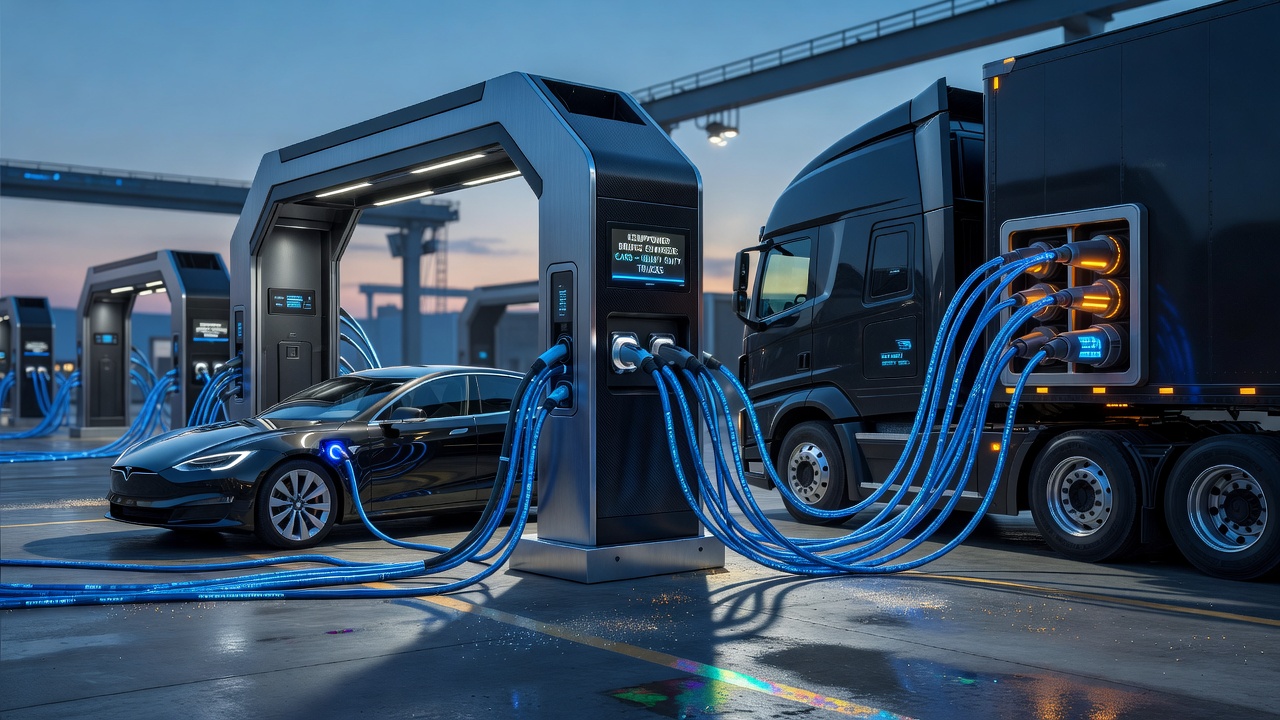
Kempower has introduced a charging dispenser designed to serve both electric passenger vehicles and heavy-duty trucks from a single unit, a move that addresses one of the more awkward problems facing the charging industry: how to build infrastructure for two very different vehicle classes without doubling the cost of every site. The new Mega Satellite Flex supports the established CCS standard at up to 560 kW alongside the emerging Megawatt Charging System, or MCS, at up to 1.2 MW, making it the company's first dispenser capable of switching between the two.
The timing reflects where the industry actually stands. CCS remains the dominant standard for charging cars and light commercial vehicles across North America and Europe, while MCS is still in the early stages of deployment, built specifically for the punishing power demands of electric semi-trucks and other heavy freight vehicles. Fleet operators planning long-haul routes have had to think carefully about charging stops in the same way travelers think about staying safe on hotel Wi-Fi during a trip - both require infrastructure that works reliably regardless of who else is using it or what device they've brought along. A charger that can flex between standards removes some of that planning burden, letting a single site accommodate whatever pulls in, whether it's a sedan or an articulated truck. staying safe on hotel Wi-Fi
Why One Dispenser for Two Standards Matters
Building charging infrastructure has historically meant making a bet on which vehicles will show up. Sites optimized for passenger cars often lack the power capacity or connector type needed for trucks, and vice versa. That has pushed operators toward separate buildouts - one installation for cars, another for freight - which multiplies land, permitting, and construction costs. Kempower's approach collapses that into a single deployment. A site owner can install the Mega Satellite Flex now and serve current CCS demand, then shift capacity toward MCS as truck traffic grows, without ripping out equipment or adding a second charging area later.
The unit also supports 800-volt vehicle architectures, an increasingly common feature in newer EVs designed for faster charging. Pairing that capability with high-amperage output - up to 700 amps for CCS and 1,500 amps for MCS - means the charger can serve a wide range of vehicles at speeds that make sense for their respective use cases, from a quick top-up for a car to the higher-throughput sessions trucks need to stay on schedule.
What It Means for Operators
For companies operating charging sites, utilization is the metric that determines profitability. A charger sitting idle because it only serves one vehicle type is a poor use of capital. By supporting both standards, the Mega Satellite Flex is designed to keep utilization higher from the moment it's installed, which shortens the path to recovering the upfront investment. The unit's cable lengths - 5 meters for CCS and 2.7 meters for MCS - are sized for the different parking and docking configurations cars and trucks require, and an optional payment terminal allows the same dispenser to serve public retail customers as well as fleet accounts.
Kempower has also built the new charger to work with its existing distributed charging architecture, meaning operators already using the company's systems can add the Mega Satellite Flex without reconfiguring their power distribution or site layout. The charger was unveiled at the company's Unplug & Recharge event held alongside ACT Expo, and it is expected to reach North American and European markets in July 2026 - a timeline that gives operators a concrete window to plan sites capable of serving both today's EVs and the heavier-duty trucks arriving in the years ahead.