
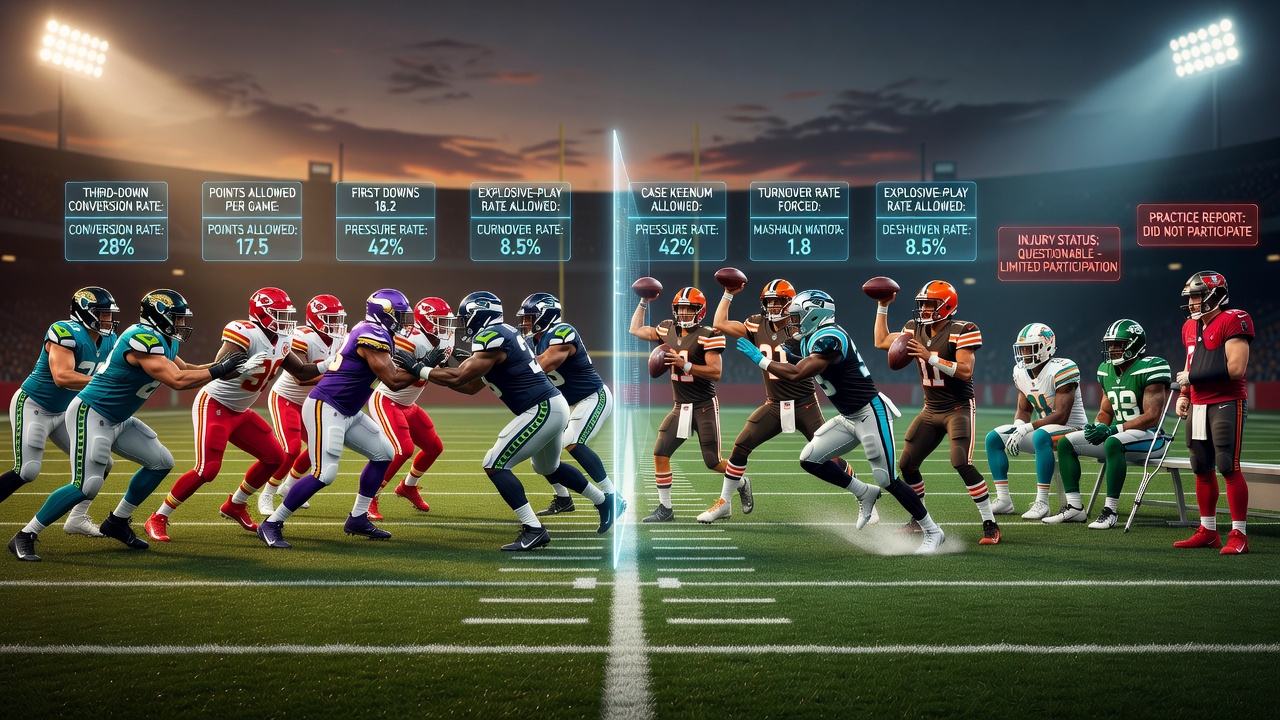
Backup quarterbacks beat the odds across the league this week, and the fantasy defenses built to exploit them paid the price. Case Keenum and Marcus Mariota each delivered unexpected wins against favored opponents, while Deshaun Watson extended his surprising run with the Browns against a Panthers team that had been trending upward. The pattern is a useful corrective for anyone building a fantasy defense lineup around the assumption that a backup quarterback automatically means an easy matchup.
Why Matchup-Chasing Is a Flawed Strategy
The temptation to start a defense simply because the opposing offense is missing its starting quarterback is understandable, but the data this season argues for restraint. A defense's underlying performance in categories like third-down conversion rate, points allowed, and first downs allowed tends to predict fantasy output better than opponent quality alone. That's the premise behind the Best Overall Defense model discussed here, which weighs those three metrics most heavily, followed by pressure rate, passes defended, turnover rate, and explosive-play rate allowed. Vegas implied team totals are folded in as well, since a defense facing a team expected to score just 16 or 18 points carries a different risk profile than one facing a team near 27.
This week's example is instructive. A string of injuries, including De'Von Achane, Breece Hall, and likely Baker Mayfield, has created a wave of backup-quarterback matchups. Rather than reflexively rostering every defense facing a diminished offense, the more disciplined approach is to separate genuinely elite units from those propped up only by circumstance. That distinction explains why a defense like the Jaguars can rank well above consensus despite a tough matchup on paper, and why the Chiefs deserve more trust than their public perception suggests.
Reading the Signals Correctly
Some defenses look appealing purely because of opponent injuries, but the deeper metrics don't always support the hype. The Ravens, for instance, grade out as middle-of-the-pack across most categories this season, with their matchup appeal driven almost entirely by a lowered opponent implied total. Contrast that with units like the Vikings or Seahawks, which rank near the top of the league in multiple core categories independent of who they're facing. The gap between a defense that creates its own opportunities and one that simply benefits from facing a backup quarterback is often the difference between a repeatable, predictable floor and a one-week mirage.
Injuries along both the offensive and defensive side also complicate the picture. A banged-up offensive line, a missing receiver, or a hobbled running back can swing a matchup as much as a quarterback change. Tracking practice reports and beat-writer notes on linemen, not just skill-position starters, often reveals more about a defense's weekly upside than headline injury news alone.
What This Means for Fantasy Decision-Making
The broader lesson applies well beyond this particular week. Fantasy defense is one of the more volatile scoring categories in the format, and overreacting to a single data point, whether that's a backup quarterback starting or a lopsided Vegas line, invites inconsistency. A more sustainable approach treats matchup context as one input among several, alongside pressure generation, turnover creation, and the ability to get off the field on third down.
None of this guarantees results in any given week; defense remains one of the hardest positions to forecast reliably, and even strong underlying profiles can produce disappointing box scores. But leaning on process over narrative, and tracking how often top-10 predictions actually land, offers a more honest way to evaluate performance over a full season than chasing whichever team happens to be without its starting quarterback.