
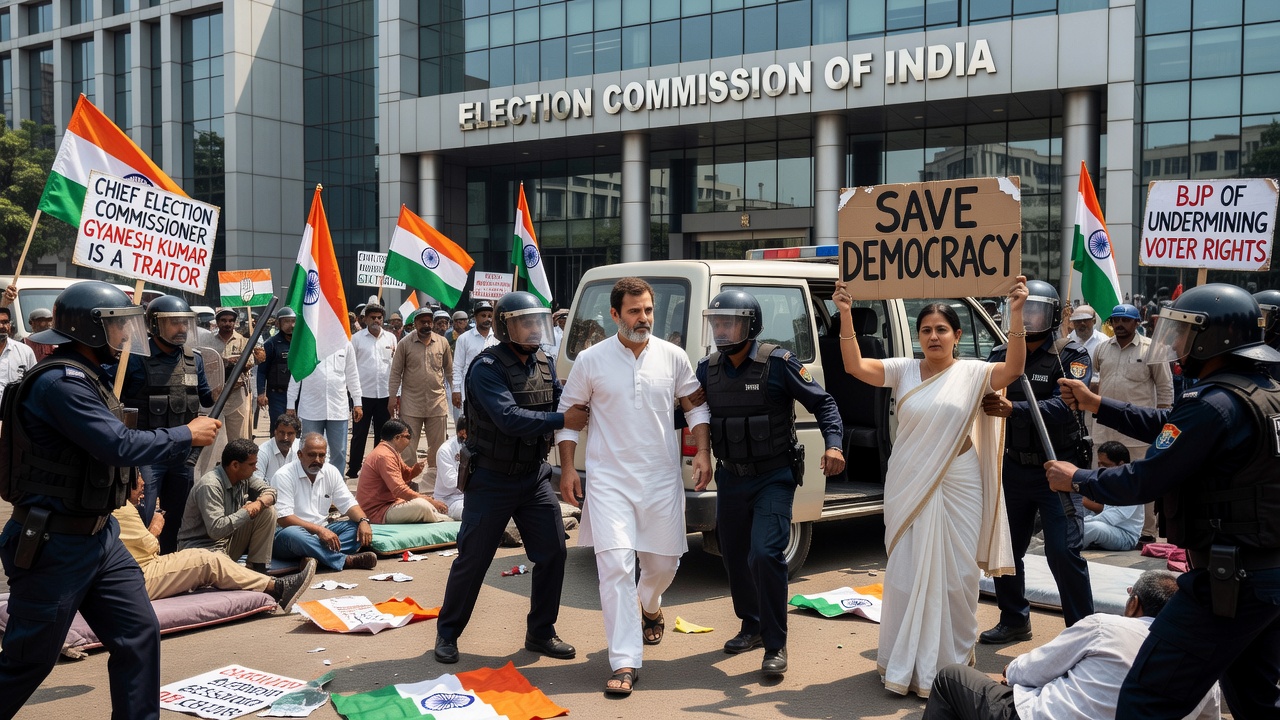
Delhi police dismantled an opposition sit-in outside the Election Commission of India's headquarters on Tuesday, briefly detaining Congress leader Rahul Gandhi, his sister Priyanka Vadra and dozens of other lawmakers. The crackdown followed weeks of mounting pressure on Chief Election Commissioner Gyanesh Kumar over allegations that voter rolls were altered in ways that favour Prime Minister Narendra Modi's governing party.
What triggered the standoff
The dispute traces back to a newspaper report describing internal disagreements within the Election Commission over how voter lists were updated. Reuters has not independently verified that report, but it was enough to galvanise opposition parties and a youth movement known as "cockroach" into near-daily street protests over the past week. Congress and allied parties argue the revisions to electoral rolls quietly tilt the playing field toward the Bharatiya Janata Party. The BJP and the Election Commission reject that characterisation, and Kumar himself has not addressed the allegations publicly.
The question at the centre of the dispute is not abstract. Voter lists determine who can cast a ballot, and in a democracy of India's scale, even modest procedural shifts in registration or removal of names can ripple through tightly contested constituencies. That is why accusations of institutional bias against an ostensibly independent body carry weight well beyond the immediate protest.
From march to detention
Tuesday's events unfolded in stages. Lawmakers marched from parliament through central Delhi, carrying placards and the national flag, some labelling Kumar a "traitor" and accusing the BJP of undermining voting rights. The march ended at the Election Commission's gates, where hundreds of security personnel in riot gear blocked entry. Gandhi and colleagues then staged a sit-in on mattresses on commission grounds, vowing to remain "as long as we have to."
Police moved in that evening, loading several lawmakers into vehicles. Delhi Police said the detentions were necessary to preserve public order and safety; Congress confirmed those detained were later released. The Election Commission said it had offered to receive the lawmakers' memorandum through an official, and separately proposed a meeting, but the venue did not meet its protocol - an offer the lawmakers declined.
A test of institutional independence
For Modi's government, the episode lands at an awkward moment, just months after student-led protests over exam paper leaks forced out his education minister. It signals that youth and opposition mobilisation, once dismissed as sporadic, is becoming a recurring feature of his third term.
The deeper issue is institutional trust. Election commissions function as neutral arbiters only if the public believes they are insulated from the government that appoints their leadership. Kumar was appointed by the Modi government, a fact opposition leaders now cite as grounds for suspicion rather than proof of wrongdoing. BJP spokesperson Sudhanshu Trivedi has called the claims baseless and misleading.
Whether the underlying allegations about the voter rolls hold up remains unresolved. What is already clear is that the confrontation has moved from newsroom reporting to the streets, and from the streets into physical clashes with police - raising the stakes for an institution that depends on being seen as above the political fray it now finds itself inside.