
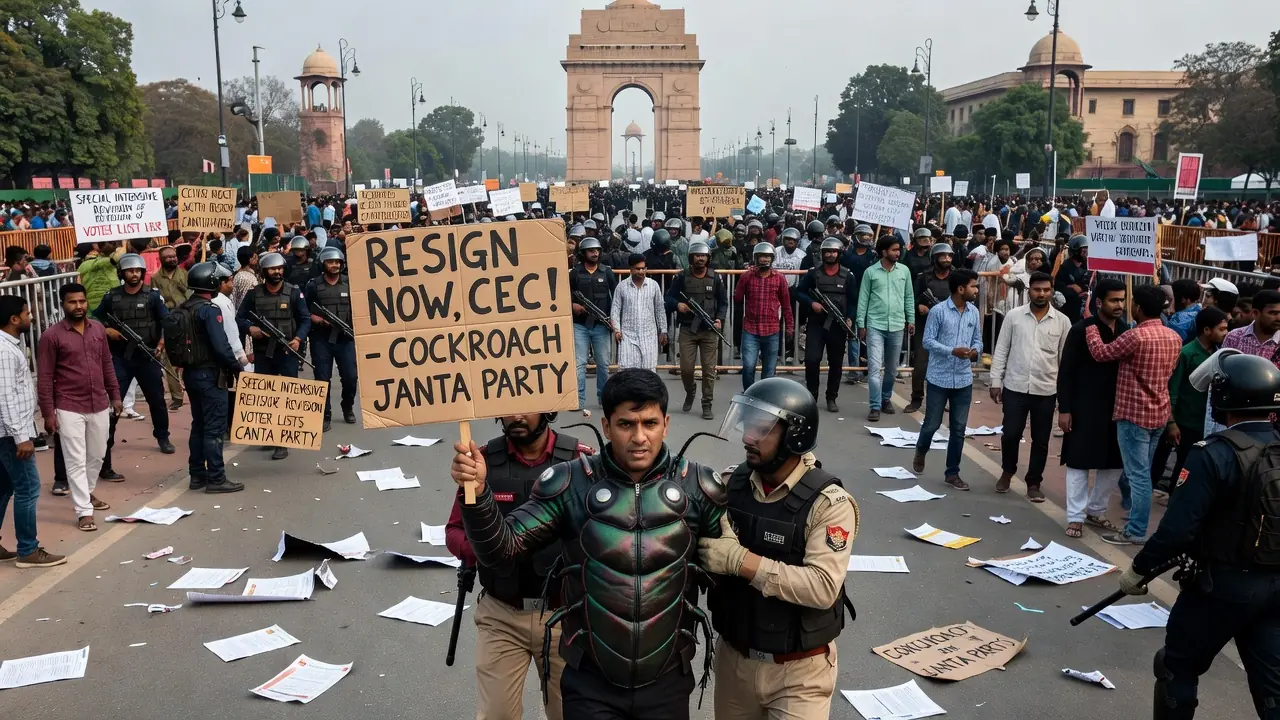
New Delhi came under an extraordinary security lockdown as police detained Abhijeet Dipke, founder of the satirical Cockroach Janta Party, along with hundreds of other demonstrators, to prevent a rally demanding the resignation of India's chief election commissioner. Thousands of security personnel were deployed, travel routes restricted, and telecommunications links suspended across parts of the capital, underscoring how seriously authorities treat a dispute rooted in a technical-sounding bureaucratic exercise: the revision of voter lists.
Why a Voter Roll Review Became a National Flashpoint
The controversy centres on the Special Intensive Revision, a process launched last year that shifts the burden of proof onto existing voters rather than election authorities. Citizens must produce decades-old documentation - birth records, land titles, school certificates - to stay on the rolls. For a country of more than 1.4 billion people, where many lack formal paperwork or have migrated across state lines for work, this is not a minor administrative hurdle. A mismatched spelling in an old record can be enough to strip someone of their vote, and with it, access to welfare schemes tied to electoral registration.
Opposition parties argue the exercise has disproportionately removed Muslim voters and other groups unlikely to support the governing Bharatiya Janata Party, pointing to deletion patterns in West Bengal, Bihar, Delhi and Assam. More than 130 million names have reportedly been removed from the rolls nationwide, feeding allegations that the process has quietly reshaped recent state election outcomes. The matter is now before the Supreme Court, while critics, including a former chief election commissioner, say public trust in the institution has collapsed.
From Online Satire to Street Movement
The Cockroach Janta Party's trajectory illustrates how quickly online dissent can translate into organised offline pressure. Formed in May after India's Chief Justice compared unemployed youth and activists to "cockroaches," the group first mobilised around exam-system failures, eventually forcing the resignation of the education minister in July following weeks of mass protests and clashes with police. Its pivot in October to challenging the chief election commissioner shows a movement testing whether the same playbook - satire, mass youth participation, and sustained pressure - can work against an institution far more central to the state's legitimacy.
- June-July: Protests over exam failures culminate in the education minister's resignation.
- October 2: "Protest 2.0" launched, targeting the chief election commissioner.
- October 10: National rally blocked; leaders detained on arrival in Delhi.
Detentions, Press Access, and the Rights Question
Amnesty International has said more than 5,000 people, including opposition leaders, student organisers, journalists and lawyers, were detained, calling it an attempt to suppress dissent and urging unconditional release of those held for peaceful assembly. The Committee to Protect Journalists separately raised concern over reporters being detained, restricted, and having equipment confiscated while covering the protests, calling for unrestricted press access. The government has rejected these characterisations, with a BJP spokesman describing protesters as "anarchic elements" and insisting the unrest does not reflect the country's broader mood.
The detention of prominent opposition figures, including former chief ministers from rival parties, alongside student leaders and rights activists, signals how the government has chosen to treat the protest less as a policy disagreement and more as a security matter. That choice carries its own risks: commentators note the crackdown lands at a moment of unusual political vulnerability for the ruling party, and heavy-handed suppression of a youth-driven movement could prove more combustible than the underlying grievance itself.
What Is at Stake for Electoral Trust
Elections depend on perceived fairness as much as procedural correctness. When an election commission's own methodology becomes the subject of mass protest, legal challenge, and international rights criticism simultaneously, the institution's credibility - not just its policy - is on trial. How Delhi handles dissent over the voter list revision will shape whether India's electoral machinery is seen, domestically and abroad, as a neutral arbiter or an instrument of incumbency.