
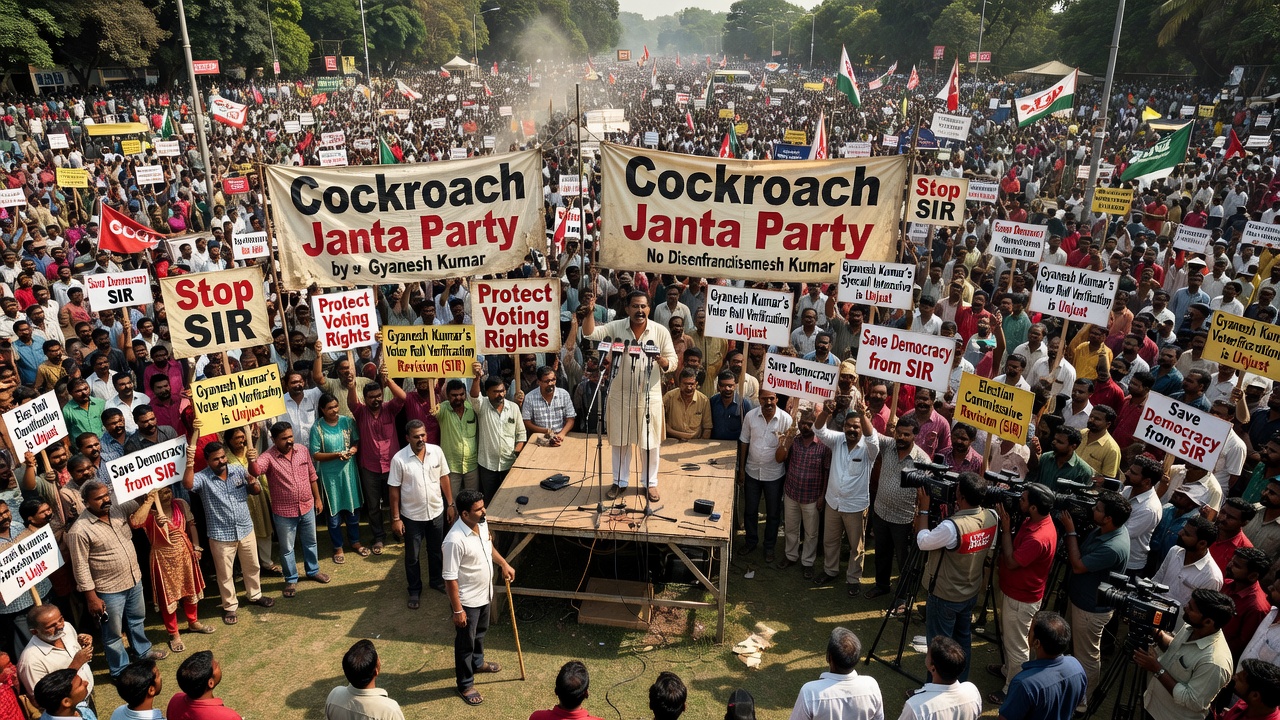
A fringe political outfit calling itself the Cockroach Janta Party has stepped into the growing dispute over the Election Commission's Special Intensive Revision process, claiming its Mumbai demonstration drew a crowd large enough to prove public discontent. Party spokesperson Saurav Das told India Today that Shivaji Park, the historic ground long associated with mass political gatherings in the city, was "full" and "overflowing with people" during the protest against Chief Election Commissioner Gyanesh Kumar's revision drive.
What the Protest Was Actually About
The Special Intensive Revision is an exercise meant to update and verify electoral rolls, a routine but sensitive administrative function that determines who is eligible to vote. Critics of the process argue that aggressive revision drives can inadvertently or deliberately strip legitimate voters from the rolls, particularly those who struggle to produce documentation on short notice. Supporters of the Commission's approach counter that periodic verification is necessary to keep voter lists accurate and prevent duplication or fraud. Das framed his party's objection around voting rights, suggesting the revision process risks disenfranchising segments of the electorate rather than simply cleaning up administrative records.
A Pattern of Protest and Pushback
The Mumbai gathering was not an isolated event. Das indicated plans to extend demonstrations to Karnataka, Uttar Pradesh and West Bengal before the party regroups in Delhi, suggesting a coordinated, multi-state campaign rather than a one-off local grievance. That ambition takes on sharper meaning alongside what happened in Delhi itself, where similar protests resulted in more than 1,000 detentions. The scale of that response illustrates how contentious the SIR process has become and how unevenly authorities are handling dissent across different cities. Das also criticised restrictions placed on protest venues, a complaint that touches on a recurring tension in Indian civic life between the right to assemble and administrative control over public spaces.
The Commission's Parallel Response
While protests unfolded on the streets, the Election Commission moved on a separate track, announcing a special voter enrolment drive. That timing matters. It signals an attempt to address concerns about exclusion through an official mechanism rather than through confrontation, even as critics continue to question whether the underlying revision methodology is sound. Whether the enrolment drive meaningfully addresses the grievances raised by protesters, or simply runs parallel to them without resolving the core dispute, remains an open question that will likely shape how the issue plays out in the states Das named.
Why the Scale Claims Matter
Das's emphasis on Shivaji Park being "overflowing" is a familiar tactic in Indian political messaging, where turnout at a single rally is often used as shorthand for broader public sentiment. Such claims are difficult to verify independently and tend to be contested by rival parties and authorities alike. What is clearer is the asymmetry between cities: a loud, visible protest in Mumbai against detentions numbering over a thousand in Delhi points to a fragmented national response to the same policy, with different local authorities calculating risk and tolerance for dissent differently.